November 2, 2026 · conroe
Roof Repair vs Replacement for Conroe Homes: How to Tell
Repair or replace? A Conroe homeowner's decision guide: roof age, how far the damage spreads, layers, decking, and the proof to ask for before you sign.
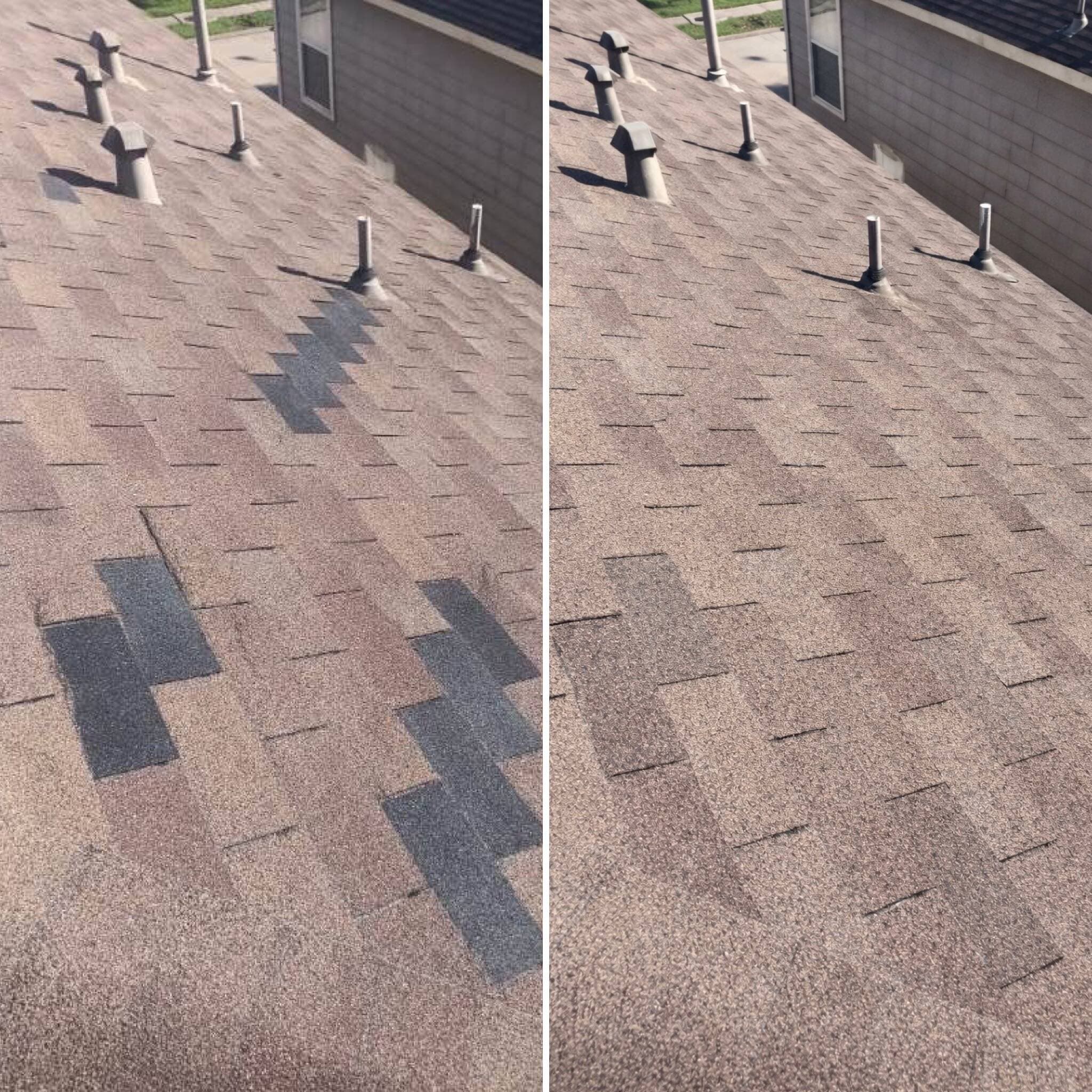
Repair the roof when the problem is in one place, the rest of the roof still has life in it, and the decking underneath is sound. Replace it when the wear shows up on every slope, the same areas keep failing, there's already more than one layer up there, or the decking has gone soft. Whichever way the call goes, it should come with photos of what's wrong and an itemized estimate, so you can check the reasoning yourself instead of taking someone's word for it.
Why is the call different from house to house in Conroe?
Conroe's housing stock is unusually mixed for one city, and that changes the answer. A newer home in Grand Central Park or Jacobs Reserve may still have its original builder-grade shingles. Five minutes away, a 1970s ranch on Gladstell may be on its second or third roof. Those two houses can have the same leak and need completely different fixes.
Location inside town matters too. Mature trees along the League Line Road corridor mean limb strikes, which tend to be damage in one spot. Shaded lots off Longmire hold moisture, so moss and granule wear show up there first and spread across a slope. Wind damage from the May 2024 derecho and Hurricane Beryl is still surfacing as slow leaks in south and east Conroe. And the clay-heavy soils here shift with drought cycles, which can crack flashing seals on one-story homes. That last one is often a flashing repair, not a roof replacement, even when the stain on the ceiling looks alarming.
What four factors decide repair or replacement?
Age: how much life does the roof have left?
Start by finding out when the roof went on; closing documents or the previous owner can usually tell you. Texas heat and UV wear shingles faster than the rating on the bundle suggests, so an older roof is already on the clock. Age alone doesn't decide anything, though. An older roof with one cracked pipe boot is still a repair. Age plus a second factor below is when replacement belongs in the conversation.
Extent: is it one spot or the whole roof?
Shingles lifted along one edge after a front, a leak at one vent, a section dented by a limb: a contained problem is a repair. Curling, cracking, or bare spots on every slope means the shingles themselves are wearing out. Patching one area of a roof that's wearing out everywhere just moves the next leak somewhere else.
Layers: how many roofs are on the house?
Some older homes have a second layer of shingles laid over the first. That adds weight, hides what's underneath, and makes repairs harder to blend. With more than one layer already up there, most roofers will recommend tearing off to the deck so the decking can be seen.
Decking: what's under the shingles?
The decking is the plywood or boards the whole roof is fastened to. If it's solid, a repair has something good to hold onto. If it's soft, sagging, or rotted across a wide area, new shingles on top won't last, and the fix gets bigger. A dip in the roofline you can see from the street is often a decking problem.
Repair or replace: how do the signs line up?
| Factor | Points toward repair | Points toward replacement |
|---|---|---|
| Age | Roof still has plenty of life left | Roof is near the end of its life |
| Where the damage is | One area, one cause (limb, vent, wall flashing) | Wear or damage on most or all slopes |
| Repair history | First repair, or a clear one-time cause | The same areas keep getting repaired |
| Layers | One layer | Two or more layers already on the house |
| Decking | Solid under and around the problem | Soft, sagging, or rotted across a wide area |
| Shingle condition | Shingles flat, sealed, holding granules | Curling, cracking, heavy granule loss |
| Matching | Replacement shingles can blend in | Old shingles are faded or no longer made |
Most answers in one column? That's usually your answer. Split? Ask for both options in writing.
What drives the cost of each option?
We don't publish prices, because the itemized estimate for your roof is the price. But it helps to know what moves the number.
A repair depends on:
- which component failed: a pipe boot, wall flashing, a valley, or a field of shingles,
- how steep the roof is, how high, and how easy the spot is to reach,
- whether the decking under that spot needs replacing too,
- how hard it is to match and blend the shingles.
A replacement depends on:
- the size of the roof and how many planes, valleys, and hips it has,
- the pitch,
- how many layers come off,
- how much decking turns out to need replacing once the old roof is off,
- the material you choose, plus flashing and ventilation,
- HOA rules on materials and colors, which neighborhoods like Jacobs Reserve and River Plantation have.
Put plainly: a repair that has to be redone next year isn't the cheaper option, and neither is a new roof when a pipe boot would have done it.
What proof should you ask for before you decide?
This is the part that protects you, whoever you hire. Before you agree to a repair or a replacement, ask for:
- A close-up and a wide shot of the problem. The close-up shows the damage. The wide shot shows where it is on the roof.
- Photos of every slope, not just the bad one. If someone recommends replacement, the photos should show wear across the roof. If they recommend a repair, the photos should show the rest of the roof is sound.
- Attic photos if the recommendation depends on decking or ventilation.
- An itemized, written estimate. On a close call, ask for the repair and the replacement priced side by side.
We shoot drone photos of every slope on every free estimate, so you see the whole roof and not just the spot that brought us out. If the damage came from a storm, the same proof does double duty: you file the claim; our itemized estimate is yours to share with your adjuster.
For the warning signs you can spot from the ground before you call anyone, see our sibling post on signs your roof needs replacing. And when the estimate arrives, how to read a roofing estimate walks through every line item.
Can you repair just part of an older roof?
Yes, if the problem is contained and the rest of the roof is sound. A cracked pipe boot or lifted flashing on an older roof is still a repair. If the shingles are wearing out on every slope, a patch only buys time.
Does a leak always mean I need a new roof?
No. Many leaks start at one spot: a pipe boot, a wall or chimney flashing, a valley, or shingles lifted by wind. Water travels before it shows, so finding the real entry point matters more than where the stain is.
Can new shingles match my old ones?
Often close, not always exact. Older shingles fade, and some colors and product lines are discontinued. Ask to see the match before the repair, and ask how it will blend into the surrounding field.
Why would one roofer say repair and another say replace?
Sometimes they saw different things, and sometimes one is selling. Ask both for photos of every slope and an itemized estimate. The photos should back up the recommendation either way.
Not sure which column your roof is in?
Our roof repair page covers how we find the real source of a leak and blend the fix, and when we'll tell you the repair money is better saved toward a replacement. We're based here and work across the Conroe service area every week.
Ask for a free estimate: drone photos of every slope, and an itemized written number for the repair, the replacement, or both.
Repair or replace? See the photos first.
Free estimate: drone photos of every slope and an itemized written estimate, so you can check the call yourself.
Francisco Brito, Roofing 365
Roofing & construction in Conroe, TX — written by the people on the roof, not a content farm.