
October 26, 2026 · conroe
Patio Cover, Covered Deck or Pergola: What Fits a Montgomery County Yard?
Patio cover, covered deck or pergola? How the three compare in Conroe and Montgomery County on shade, rain protection, and how each one ties into your house and roof.
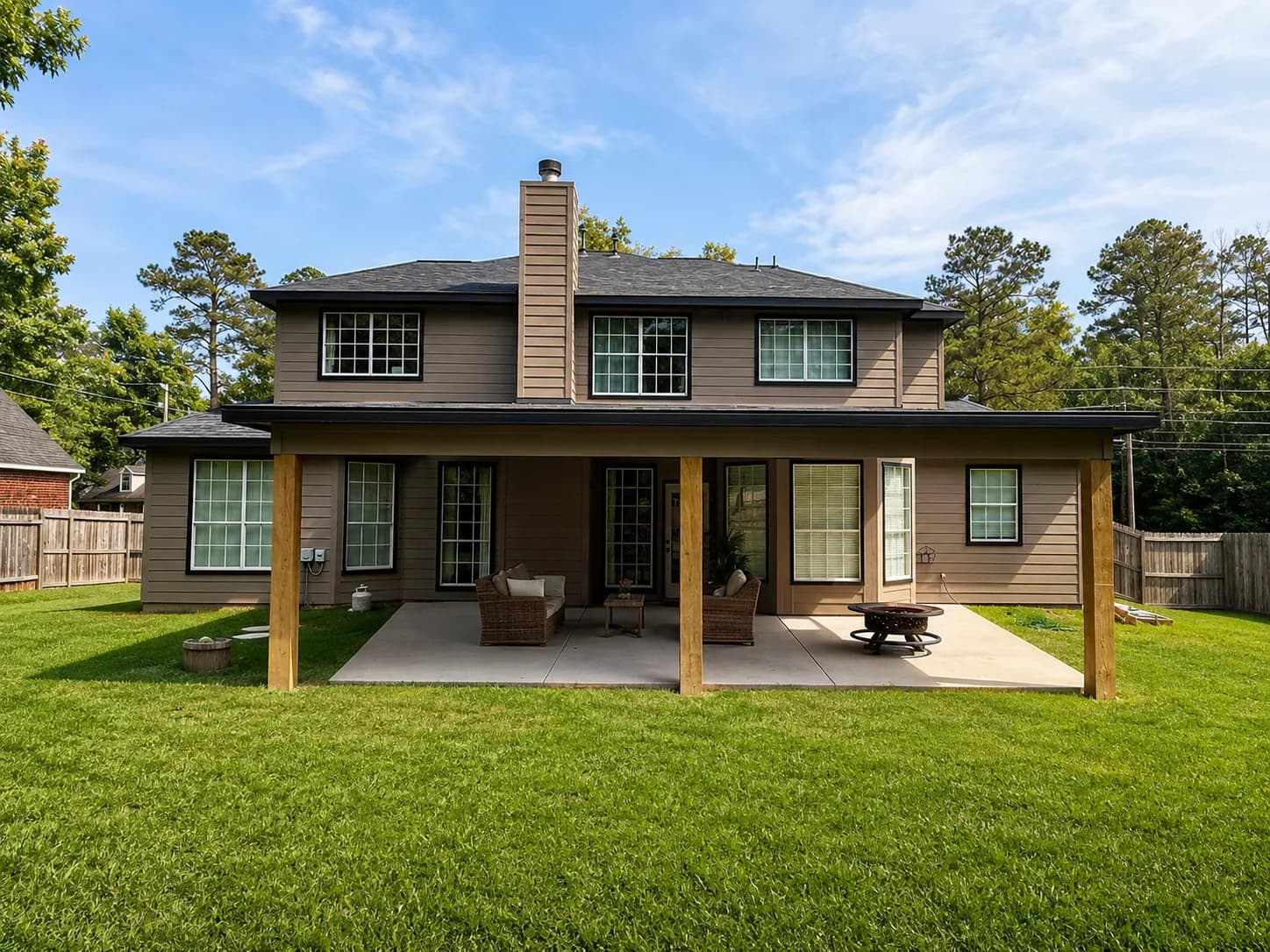
If you want to sit outside in the rain, you want a roof: a patio cover over a slab, or a covered deck if the deck is already there or the yard slopes. If you mostly want filtered shade and an open-air feel, a pergola is the lighter option. Rain still comes through, though. The real difference between the three is how much roof you're adding to the house, and where it connects.
Why the choice is different in Conroe
Back yards around Conroe take a lot of weather. Summer afternoons make a bare slab unusable from late spring into fall. I-45 storm lines and hail runs clip this part of the county more years than not. Mature trees off Longmire and around downtown drop limbs and keep shaded surfaces damp. And the newer neighborhoods like Grand Central Park and Jacobs Reserve have HOA guidelines on what you can build and what it can look like.
So the question isn't really "which one looks best." It's how much sun and rain you need to block, and how much connection to the house you're willing to take on.
What is each option, exactly?
Patio cover. A roofed structure over a patio or slab, usually attached to the back of the house. It can be a simple shed-style extension or a gabled or vaulted roof with a finished ceiling. It has real roofing on top, so it keeps rain off.
Covered deck. The same idea built over a raised wood or composite deck. The cover's posts have to land on footings that can carry a roof, so the deck framing underneath matters as much as the roof on top.
Pergola. An open frame of posts, beams and rafters or slats, attached or freestanding. It gives you shade that moves with the sun and a defined outdoor "room," but no roof. Unless you add a solid or louvered top, rain falls straight through.
How do they compare?
| Patio cover | Covered deck | Pergola | |
|---|---|---|---|
| Shade | Full shade under the roof | Full shade under the roof | Partial, filtered; depends on slat spacing and which way it faces |
| Rain | Keeps rain off | Keeps rain off | Rain comes through (open top) |
| Ties into the house | Usually, at the wall or the existing roofline | Usually, at the wall or the existing roofline | Optional; can stand alone anywhere in the yard |
| Roofing work | Yes: shingles or metal, flashing, drainage | Yes, same as a patio cover | None with an open top |
| Sits on | Existing slab or new footings | Deck framing and footings sized for a roof | Footings or a slab |
| Best for | Year-round outdoor living off the back door | Raised decks and sloped yards | Shade over a seating area, fire pit or pool edge |
What we've built around Conroe and Porter
The gallery shows three outdoor builds from this part of the county. Each one handled the house tie-in differently.
- A covered patio in Conroe. A two-story home had an open concrete slab out back. We built a roof extension on wood posts across the back of the house over that slab, tied into the house so water sheds away from the wall. Underneath it's a finished ceiling over outdoor seating, with a fire pit just past the eave.
- A covered deck in Conroe. This home already had a stained wood deck with a small original cover. We replaced the cover with a shingle-roofed gable on posts over the existing deck, framed in place with scaffolding. It has a vaulted stained-wood ceiling with white beams, and the deck sits in a yard ringed with trees.
- A vaulted patio cover in Porter. A single-story stucco home with a pool had a bare stamped-concrete patio. The layout was chalked on the slab first. The finished cover runs across the back of the house with a gabled center section and a tongue-and-groove pine ceiling.
None of these is a pergola. All three are roofed, so they keep the rain off, and each one had to connect to the house.
Where does each one connect to the house?
This is where outdoor builds go wrong, and it's the part a roofer pays attention to.
- At the wall. A patio cover or deck cover attached below the eave needs a ledger fastened to the house framing, with flashing that keeps water from running behind it. A ledger that's caulked and not flashed is a slow leak into the wall.
- At the roofline. Tying a new roof into your existing one means new valleys or a transition where the two roofs meet. Done right, it's flashed and shingled like any other part of the roof. Done wrong, it's the first place your house leaks in the next storm.
- Freestanding. A pergola, or a cover that doesn't touch the house, avoids the tie-in entirely. The tradeoff is more posts and footings, and a gap between the house and the shade.
If your main roof is near the end of its life, it's worth thinking about both at once. Tying a brand-new cover into an old roof means you'll be reworking that joint when the main roof is replaced. Our roof installation page covers what a replacement involves.
What should you check before you build?
- City and HOA rules. Rules for attached and roofed structures vary by city, county and neighborhood. Check with your city and your HOA before you settle on a design, size or material.
- Drainage. A new roof sheds a lot of water in one spot. Plan where it goes: gutters, and away from the slab and the foundation.
- Trees. If limbs hang over the spot, a roofed cover takes the hit and a pergola lets debris through. Either way, plan for the leaves and needles.
- Fans and lights. If you want them, bring in an electrician early so the wiring is planned before the ceiling is closed in.
- Which way it faces. A west-facing patio takes the hardest afternoon sun. Open slats help less there than full cover does.
Does a pergola keep the rain off?
Not with an open top. Slats or rafters filter sun but let rain through. If you want to stay dry, you need a solid roof, which makes it a patio cover, or a louvered or covered pergola top.
Can a patio cover tie into my existing roof?
Usually, yes. The new roof meets the old one at a valley or a transition that has to be flashed and shingled correctly. That joint is where poorly built covers leak, so it should be built like part of the roof.
Can you put a roof over a deck I already have?
Often, but it depends on what's under the deck. A roof adds weight, so the posts need footings and framing that can carry it. The Conroe covered deck in our gallery is a new gable roof built over an existing deck.
Do I need approval to build a patio cover or pergola?
It depends on where you live. City, county and HOA rules for attached and roofed structures vary, so check with your city and your HOA before you finalize a design.
The bottom line
Pick a patio cover or covered deck if you want to use the space in the rain, and a pergola if you want shade and an open feel. Whichever you choose, the connection to the house decides whether it lasts. Our decks, pergolas and carports page covers how we build them, and the Conroe service area page covers the neighborhoods we work in. For more on materials and orientation, see decks, pergolas and outdoor builds in Magnolia.
When you're ready to compare options for your yard, ask for a free estimate. Each option you're weighing gets its own line items, so you can see the difference before you choose.
Weighing a patio cover, covered deck or pergola?
Free estimate, itemized by option, so you can compare before you decide.
Francisco Brito, Roofing 365
Roofing & construction in Conroe, TX — written by the people on the roof, not a content farm.